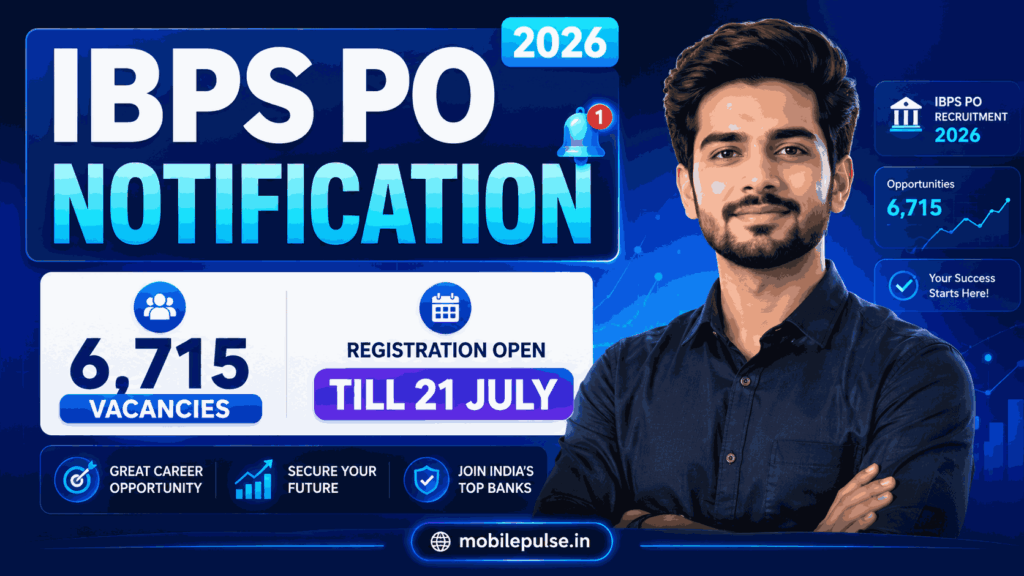
IBPS released the CRP PO/MT-XVI notification on 1 July 2026, opening 6,715 Probationary Officer vacancies across 11 public sector banks. Online registration opened 1 July 2026 and closes 21 July 2026. Three participating banks are yet to report their vacancy numbers, so this total is expected to rise before the window closes.
If you’re tracking the IBPS PO 2026 notification, the next three weeks matter more than usual. This cycle brings a genuinely revised exam pattern, a new self-correction window for application mistakes, and one of the largest vacancy jumps in recent years. This article walks through every number you need — sourced and cross-checked — before you start filling the form.
IBPS PO 2026 Notification Overview
| Particular | Details |
|---|---|
| Conducting Body | Institute of Banking Personnel Selection (IBPS) |
| Recruitment Cycle | CRP PO/MT-XVI (2027–28 vacancies) |
| Total Vacancies | 6,715 (indicative; 3 banks yet to report) |
| Registration Window | 1 July 2026 – 21 July 2026 |
| Prelims Exam Date | 22 & 23 August 2026 |
| Mains Exam Date | 4 October 2026 |
| Application Fee | ₹850 (General/OBC/EWS); ₹175 (SC/ST/PwBD) |
| Official Website | ibps.in |
| Latest Status | Registration open; vacancy count may increase |
Important Note: Treat 6,715 as a working number, not a final one. Indian Bank, UCO Bank, and Union Bank of India have listed their vacancies as “Not Reported” in the notification, and the total may increase once they announce their figures — as happened in past cycles.
Important Dates
| Event | Date |
|---|---|
| Online Registration Starts | 1 July 2026 |
| Online Registration Ends | 21 July 2026 |
| Application Edit Window | Opens for 2 days after registration closes |
| Prelims Exam | 22 & 23 August 2026 |
| Prelims Result | September–October 2026 |
| Mains Exam | 4 October 2026 |
| Mains Result | November 2026 |
| Personality Test | November 2026 |
| Interview | November–December 2026 |
| Provisional Allotment | January 2027 |
Important Note: Don’t rush to submit on day one. IBPS has introduced a new Edit Application Window that opens for 2 days after registration closes, so factual entry errors can still be fixed — but core details like Name, Email ID, Mobile Number, State/UT, Post, and Nationality cannot be edited even during this window, and category changes only run one direction (General/EWS/OBC to SC/ST/PwBD, not the reverse). Fill the form carefully the first time rather than counting on the correction window to fix everything.
Eligibility Criteria
Age Limit: Only candidates born between 2 July 1996 and 1 July 2006 can apply, meaning you must be 20 to 30 years old as on 1 July 2026, with both boundary dates included.
Age Relaxation:
| Category | Relaxation |
|---|---|
| SC/ST | 5 years |
| OBC | 3 years |
| Persons with Disability (PwBD) | 10 years |
| Ex-servicemen/Commissioned Officers | 5 years |
Educational Qualification
A graduation degree — such as BA, BCom, BSc, or B.Tech — from a university recognised by the Government of India is required.</cite> <cite index=”4-1″>Only candidates who possess the required graduation degree on or before the cut-off date specified in the notification are eligible; final-year students whose results are not declared by that date cannot apply. If your result is provisional, keep the proof of declaration ready — you’ll need it at the interview stage, not just at registration.
Vacancy Details
Bank of Baroda has announced the highest number of vacancies with 1,900 posts, followed by Canara Bank with 1,500 vacancies. Category-wise, the reported vacancies stand at roughly 1,009 for SC (with OBC, General, EWS, and ST figures completing the rest of the 6,715 total).
Participating Banks (11, excluding SBI which recruits separately): Bank of Baroda, Bank of India, Bank of Maharashtra, Canara Bank, Central Bank of India, Indian Bank, Indian Overseas Bank, Punjab National Bank, Punjab & Sind Bank, UCO Bank, and Union Bank of India.
Important Note: This year’s 6,715 figure represents an increase of roughly 1,507 vacancies — about 29% more — compared to the previous recruitment cycle, so competition per seat may ease slightly even as the exam gets tougher.
Application Fee
| Category | Fee |
|---|---|
| General / OBC / EWS | ₹850 (inclusive of GST) |
| SC / ST / PwBD | ₹175 (inclusive of GST) |
Payment can be made via Debit Card, Credit Card, Net Banking, or UPI, and bank transaction charges are borne by the candidate. The fee is non-refundable once paid, so double-check your category selection before submitting payment.
Exam Pattern (Prelims)
The prelims pattern was revised in the 2025 cycle and continues unchanged into 2026 — this is the version you’ll actually sit for:
| Section | Questions | Marks | Duration |
|---|---|---|---|
| English Language | 30 | 30 | 20 minutes |
| Quantitative Aptitude | 35 | 30 | 20 minutes |
| Reasoning Ability | 35 | 40 | 20 minutes |
| Total | 100 | 100 | 60 minutes |
Important Note: Quantitative Aptitude marks were reduced from 35 to 30, while Reasoning Ability marks increased from 30 to 40— Reasoning is now the single highest-weightage prelims section. Candidates who mentally budget equal prep time across all three sections, as older strategy guides suggest, are under-investing in Reasoning relative to where the marks actually sit. Sectional and overall cut-offs both apply, so a weak English score can eliminate you even with a strong Reasoning score.
Exam Pattern (Mains)
IBPS has revised the Mains exam pattern by increasing the number of objective questions from 145 to 170, with Banking Awareness and Data Interpretation carrying higher weightage and the English section’s marks and duration reduced. The revised structure covers Reasoning (40 questions), General Awareness/Banking/Digital Awareness (50 questions), English (40 questions), and Data Analysis (40 questions), for 200 total marks</cite>, plus a separate 25-mark Descriptive Test (Essay and Letter Writing).
Verify on ibps.in: Several portals updated their exact per-section mark breakdown within hours of the notification going live, and figures aren’t yet fully consistent across sources at the time of writing. Before you plan section-wise mains prep, confirm the precise marks-per-section split against the official notification PDF on ibps.in.
Salary & Pay Scale
A newly appointed Probationary Officer starts on the pay scale 48480-2000/7-62480-2340/2-67160-2680/7-85920, with the in-hand salary varying by posting location and applicable allowances such as DA, HRA, and special allowances. The basic pay is fixed nationally, but city-linked allowances mean your take-home amount will differ depending on where you’re posted.
Selection Process
The recruitment runs through three stages: Preliminary Exam → Main Exam → Personality Test & Interview. Prelims is purely a screening round — Prelims marks are not counted in the final merit. The final merit list combines the Mains Exam score and Interview score in an 80:20 ratio. Interview qualifying marks are set at 40%, reduced to 35% for SC/ST/OBC/PWD candidates.
Preparation Tips
Prioritise Reasoning in prelims — it now carries the most marks of the three sections, and neglecting it because it “felt like just another section” under the old pattern is the most common mistake this cycle. Don’t ignore sectional cut-offs. Clearing the overall cut-off with a weak section still gets you eliminated at prelims. Track mains prep against the confirmed 170-question, 200-mark structure, but hold off finalising your exact time allocation per section until you’ve checked the official PDF’s per-section marks. Keep your degree proof ready early. If your result is provisional, get the university’s declaration letter organised now — you’ll need it at interview stage, not registration.